
Bring Your Own Keys to ChatStudio and Keep Control
ChatStudio BYOK lets teams use the AI providers their organisation already approves, discover models directly from those providers, and calibrate execution without giving up control.
ChatStudio now supports BYOK (Bring Your Own Keys), giving teams a practical way to work with approved AI providers inside the CodeBots platform.
That matters because AI adoption inside real organisations rarely starts with a blank cheque and a clean slate. Security, procurement, architecture, and finance teams are all working through which providers are approved, how usage is managed, and where credentials are allowed to live. The result is usually not “use any model you like”. It is “use AI, but use it responsibly”.
That is exactly the kind of operating reality BYOK is designed for.
Why BYOK matters
The point of BYOK is not novelty. The point is alignment.
Many teams already have approved relationships with providers such as OpenAI, Anthropic, Google, or Mistral. Some are experimenting with Qwen through DashScope. Others want a managed option while they work through approvals. What they do not want is a separate AI island that ignores the controls the organisation has already put in place.
BYOK lets ChatStudio fit into that reality. Teams can use the providers they are already allowed to use, while still getting the benefit of ChatStudio as the governed execution surface. The work still happens inside the platform. The difference is that the model call can now happen through the provider account the organisation or user already controls.
There is also a practical cost and ownership angle here. When you bring your own key, provider billing stays with the provider relationship you already manage. That makes it easier to experiment inside the operating model your organisation is already building, rather than creating a second one just for AI.
What this looks like in ChatStudio
In ChatStudio, BYOK is built into the model selection flow rather than bolted on as an afterthought.
You choose a provider first. If that provider needs a key, ChatStudio prompts you to connect it. Once connected, ChatStudio can discover the models available from that provider and let you select the one that fits the work in front of you. The product also keeps track of your last-used provider and model, which makes repeat work much easier when a team settles into a preferred setup.
One detail worth calling out is that credentials are not being tossed around loosely. The backend stores provider keys securely and encrypts them before persistence, which is the sort of detail enterprise teams expect to be true before they trust a feature like this.
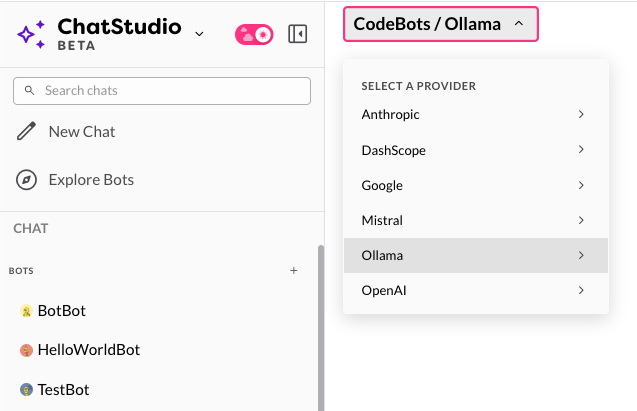
Today, the providers supported in ChatStudio are:
- Anthropic
- DashScope (Alibaba Cloud Qwen)
- Mistral
- OpenAI
- Ollama
Ollama is the built-in managed option in the current setup, so it does not require an API key. The other listed providers can be used through BYOK.
If there is a provider you need and it is not on this list, let us know.
Calibration matters too
BYOK is only part of the picture. Once teams can choose providers, the next question is how to use them well.
That is where calibration comes in.
ChatStudio already includes provider-scoped task calibration, which means teams are not locked into one model choice for every kind of work. Instead, you can calibrate model use by task, saving overrides for the kinds of execution where a faster model, a cheaper model, or a stronger reasoning model makes more sense.
That is a useful step beyond basic model switching. It means ChatStudio is not just asking, “Which provider do you want?” It is asking, “How should this provider be used across different kinds of work?” That is a much more practical question once AI becomes part of delivery rather than a one-off experiment.
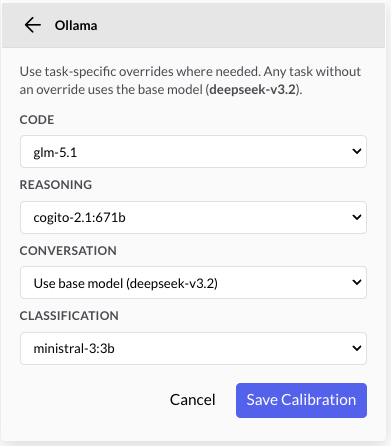
This is one of the more interesting parts of the current implementation. The calibration settings are saved per provider, so teams can discover models from a provider and then tune how those models are used across tasks without having to rebuild the workflow each time.
Why this matters for enterprise teams
This is where ChatStudio gets more interesting than a generic chat interface.
Enterprises do not just need access to models. They need a way to use models inside a workflow that remains visible, reviewable, and controllable. BYOK helps with provider choice and approval constraints, but the surrounding ChatStudio experience is what makes that choice operationally useful.
A few details from the current product are especially worth noting:
- provider and model selection happens inside the chat workflow, not in a disconnected admin tool
- model discovery is dynamic, so teams can see the models actually available through the provider they connected
- last-used provider and model choices are persisted, which reduces repetitive setup
- per-task calibration overrides let teams tune execution instead of treating all AI work as the same
That combination matters because it moves AI use a little closer to an operating model and a little further away from ad hoc prompt chasing.
It also gives teams a practical bridge while approvals are still evolving. You can move now with approved providers, keep control over who is connected to what, and still work inside a governed platform experience.
What comes next
This is not the end state.
Today, BYOK is user-based. That is a good starting point because it lets people connect approved providers quickly and begin working inside ChatStudio with minimal friction. The next development step is organisation-wide BYOK, so teams can manage provider access at the organisation level instead of relying only on per-user keys.
That shift matters because many organisations want provider control to live at the same level as policy, finance, and architecture decisions. User-based BYOK gets the workflow moving. Organisation-wide BYOK is the next step toward making that control model stronger.
If you want to try ChatStudio now:
And if the provider you need is not listed yet, tell us. That is exactly the kind of feedback that helps shape what BYOK should support next.
Discover More
Turning Paths into Organisational Memory
CodeBots helps teams publish new paths into durable knowledge, so what works in one project can guide future work through Docs and ChatStudio.
Follow Golden Paths with ChatStudio
ChatStudio Path Explorer helps teams follow golden paths instead of starting from a blank prompt, turning reusable bot knowledge into guided, governed work.

ChatStudio is Here
ChatStudio is now part of the CodeBots platform, giving teams a governed way to turn structured intent into execution, capture meaningful outcomes, and lay the groundwork for self-improving AI delivery.